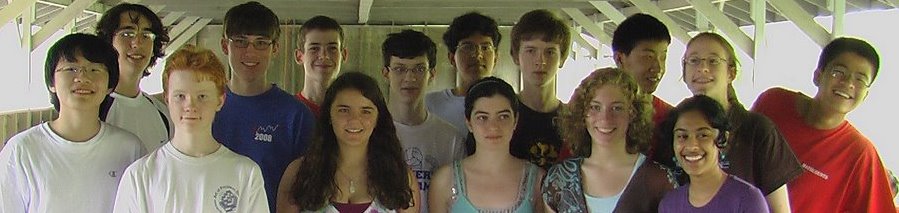
We again encourage our high school students to coach MATHCOUNTS teams and/or to organize and lead small middle school math circles for students in their areas.
Albany Area Math Circle is also offering something new for middle school students this year.
We will have a special monthly "Middle School Math Meet" event once a month.
Our first "Middle School Math Meet" event will be hosted by the Hebrew Academy of the Capital District on Tuesday October 12.
The meet will officially start at 4:15, but we will offer warmup activities for students who can arrive at 3:45. The meet will end by 5:30. Refreshments will be served. Students should bring pencils with good erasers. Please leave your calculators at home!
We will rotate days and locations for this monthly event in future months, including Sunday afternoons as well as weekday afternoons, so don't be discouraged if Tuesday afternoons are not good for you.
We also plan to rotate locations for this event, so please let us know if you would like to arrange for your school to host a future math meet. A special thanks to Hebrew Academy of the Capital District for "breaking the ice" and hosting the first one!
Parents of students who would like to participate in the October 12 math meet should use the form at this link to register their student.
Monday, September 27, 2010

Saturday, September 25, 2010
Princeton University Math Contest (PUMaC)
Albany Area Math Circle plans to participate in PUMaC again this year. This is a very challenging and exciting experience run by the undergraduate math students at Princeton University each year since 2006.
(It's exciting that two of our alumni are now undergraduate students at Princeton. Both Andrew Ardito and Dave Bieber participated in PUMaC throughout their high school years, and I'm sure they and all the students involved are eager to draw on their experiences to contribute their ideas to make this year's contest even better.)
Albany Area Math Circle teams have done very well in the past, and we plan to send two teams this year.
More information about PUMaC is available here.
Here are the key dates that Albany Area Math Circle students need to keep in mind for PUMaC:
As soon as possible, email me at mathcircle@gmail.com to let me know of your interest, even if you are not yet entirely sure of your schedule and ability to commit. We'll be happy to answer questions and to put your parents in touch with other parents whose students are considering going so they can discuss possible carpools and hotel-room sharing arrangements, etc. among themselves.
Sunday October 10: Deadline to inform me of a firm commitment to participate.
Saturday November 13 through November 19: Power Round of PUMaC All 8-person teams will work collaboratively during this time to solve and write up solutions to a multipart Power Round problem. Math circle students will do this collaboration mostly via Internet, and it's important that students who sign up for PUMaC make sure they will have time to work on the problems during this period and contribute to the solution and writeup.
Saturday November 20: All day on-site contest at Princeton University. The Power Round will be turned in at the beginning of the day. The remaining rounds (Individual Subject Tests and collaborative Team Round Test) will take place this day, along with a number of just-for-fun "Mini-Events" that don't count toward the final team ranking (Math Bowl, Rubiks Cube, Useless Math Olympiad, Chess, etc.)
For more information, you may want to talk to students who have gone in the past about their experiences. Veterans from last year who have already notified me of their enthusiastic plans to return this year are: Matthew Babbitt, Gurtej Kanwar, Zubin Mukerjhee, and Jay White. Ashley Cho is also definitely going. Once we have the team composition settled, we will hold a preliminary organizational meeting to help our first-time participating students prepare to make the most of this exciting opportunity.
I have created a special google groups email discussion list for Albany Area Math Circle students who are possibly interested in going to PUMaC this year. Even if you are not sure if you can go yet, you are welcome to join the group to find out more about preparing for PUMaC. Email me as soon as possible if you are interested in PUMaC for this year and I'll add you to the list.
UPDATE: See comments below for questions and answers from math circle students about how PUMaC is going to work.
(It's exciting that two of our alumni are now undergraduate students at Princeton. Both Andrew Ardito and Dave Bieber participated in PUMaC throughout their high school years, and I'm sure they and all the students involved are eager to draw on their experiences to contribute their ideas to make this year's contest even better.)
Albany Area Math Circle teams have done very well in the past, and we plan to send two teams this year.
More information about PUMaC is available here.
Here are the key dates that Albany Area Math Circle students need to keep in mind for PUMaC:
As soon as possible, email me at mathcircle@gmail.com to let me know of your interest, even if you are not yet entirely sure of your schedule and ability to commit. We'll be happy to answer questions and to put your parents in touch with other parents whose students are considering going so they can discuss possible carpools and hotel-room sharing arrangements, etc. among themselves.
Sunday October 10: Deadline to inform me of a firm commitment to participate.
Saturday November 13 through November 19: Power Round of PUMaC All 8-person teams will work collaboratively during this time to solve and write up solutions to a multipart Power Round problem. Math circle students will do this collaboration mostly via Internet, and it's important that students who sign up for PUMaC make sure they will have time to work on the problems during this period and contribute to the solution and writeup.
Saturday November 20: All day on-site contest at Princeton University. The Power Round will be turned in at the beginning of the day. The remaining rounds (Individual Subject Tests and collaborative Team Round Test) will take place this day, along with a number of just-for-fun "Mini-Events" that don't count toward the final team ranking (Math Bowl, Rubiks Cube, Useless Math Olympiad, Chess, etc.)
For more information, you may want to talk to students who have gone in the past about their experiences. Veterans from last year who have already notified me of their enthusiastic plans to return this year are: Matthew Babbitt, Gurtej Kanwar, Zubin Mukerjhee, and Jay White. Ashley Cho is also definitely going. Once we have the team composition settled, we will hold a preliminary organizational meeting to help our first-time participating students prepare to make the most of this exciting opportunity.
I have created a special google groups email discussion list for Albany Area Math Circle students who are possibly interested in going to PUMaC this year. Even if you are not sure if you can go yet, you are welcome to join the group to find out more about preparing for PUMaC. Email me as soon as possible if you are interested in PUMaC for this year and I'll add you to the list.
UPDATE: See comments below for questions and answers from math circle students about how PUMaC is going to work.
Wednesday, August 4, 2010
Andrew Ardito: Soul of the Albany Area Math Circle
.jpg) Andrew Ardito, our math circle's captain for the past three years, has racked up an extraordinary string of accomplishments during his time with our math circle. His infectious passion for problem solving challenges has inspired many others in our math circle community, both younger and older, and we will all miss him enormously as he heads off to college this fall.
Andrew Ardito, our math circle's captain for the past three years, has racked up an extraordinary string of accomplishments during his time with our math circle. His infectious passion for problem solving challenges has inspired many others in our math circle community, both younger and older, and we will all miss him enormously as he heads off to college this fall.Andrew is a homeschooled student from Coxsackie whose accomplishments go well beyond mathematics. By the end of his junior year of high school, he had already reached National AP Scholar status by getting high scores on nine AP exams, and he took five additional AP exams in his senior year. Those 14 AP exams covered a wide variety of disciplines including literature, art history, US and world history, economics and government, as well as mathematics and all the natural sciences. He also managed to find time to study four years of Russian during high school. He went into special depth in mathematics and physics, taking several advanced physics classes at SUNY Albany as well as even more advanced math classes at SUNY Albany and RPI, including number theory, topology, analysis, and a graduate class in combinatorics. His many honors also include a National Merit Scholarship and a Robert C. Byrd Scholarship. In addition, Andrew has won numerous awards for chess, as well as coaching a chess club for younger students.
Andrew started out as one of the youngest members of our first middle school math circle, back in 2003. He eagerly moved on to greater and greater challenges, taking over as captain of our high school math circle in his sophomore year of high school. He also student-coached MATHCOUNTS teams throughout his high school years. In his junior year, he helped spur a reinvorigation of our middle school math circles, and he leaves a remarkable legacy of inspiring leadership behind, as he has worked with so many students who have already demonstrated great promise as mentors themselves.
He is an outstanding example of the guiding principle of our math circle: the best way to learn is to share what you think you already know with someone else, because explaining it to them deepens your own understanding.
Andrew has accumulated an extraordinary number of accomplishments during his time as a member of our math circle, both in mathematics and in other areas.
A partial list of his many honors in mathematics include:
 ☞ National MATHCOUNTS contestant all three years as a member of the New York State team in middle school. As a 7th and 8th grader, he won the New York State championship and made the National Countdown Round in both years, placing sixth on writtens in 2005 and and 2nd place in the country at MATHCOUNTS Nationals Countdown in 2006. He also provided team leadership to two Chapter-winning teams, one of which came in 3rd place in the state.
 ☞ As a high school student, Andrew coached many successful MATHCOUNTS teams, including several teams that won Chapter championships and one team that won a state championship. He also coached many students who won high individual honors at Chapter and State MATHCOUNTS contests, including quite a number of Chapter and State CountDown participants and National MATHCOUNTS contestants. His mentorship and enthusiastic example has also inspired many younger students to embrace some exciting and challenging high school contests while still in middle school, including AMC10/12, HMMT, and NYSML/ARML.

The photo above shows Gili Rusak, a 7th grader at Shaker Junior High, and Aniket Tolpadi, an 8th grader at Iroquois Middle School, working with Andrew in a middle school math circle meeting. Both Gili and Aniket qualified for the American Invitational Math Exam (AIME) this year. Gili was the only 7th grader in the state to qualify for this exam, while Aniket was one of only four 8th graders in the state to do so.
☞ Andrew has earned many outstanding honors in high school math contests: he began taking the AMC high school contests in sixth grade and has won many honors in that series: he qualified for the AIME seven times, for the USA Math Olympiad five times. In 2007, he qualified for the Math Olympiad Summer Program; in 2008, he was the top scorer in the state on the AMC12B, and he also won an AMC12 gold medal for his consecutive four years as math circle's high scorer on the 12A and/or 12B.
Andrew has consistently been among Albany Area Math Circle's top three scorers on the AMC12 in every year since he began taking that exam in seventh grade, helping the math circle teams score among the top teams in the state each year. In February 2010, in his final attempt at the AMC12, he contributed to a record best-ever team
 performance by any Albany Area Math Circle on any AMC math contest--the Albany Area Math Circle AMC12B team of Dave Bieber, Andrew Ardito, and Schuyler Smith placed first in New York State. Indeed their team's performance on that remarkably challenging 2010 AMC12B contest was among the top five team scores in the country. Two younger students whom Andrew has coached in the past both earned top individual honors on honor roll for AMC12A/B: Schuyler Smith tied for high-scorer in the NY-NJ region on that contest, and Matthew Babbitt earned honors as the region's top-scoring student in ninth grade or below.
The first time Andrew qualified for the USA Math Olympiad, he had to take the 9-hour contest by himself, because he was the only qualifier in our area that year. However, he has generously shared his olympiad problem-solving skills with other students, and this has resulted in the camaraderie of a growing number of math olympians in our math circle taking the contest together in every year since then. This year's qualification process was exceptionally rigorous and yet our math circle had a record-tying five students taking the USA Math Olympiad, as Andrew was joined by Felix Sun (Shenendahoah HS junior), Matthew Babbitt (homeschool freshman), Schuyler Smith (homeschool junior), and Dave Bieber (Niskayuna HS senior).

There is an ancient metaphor invoked by many philosophers, mathematicians, and scientists that seems especially apt here: "standing on the shoulders of giants."
Andrew once stood on the shoulders of earlier members of Albany Area Math Circle, and he gives special credit to founding member and "soul of the Albany Area Math Circle" award-winner Drew Besse for inspiring and mentoring him.
In turn, Andrew's shoulders have surely provided strong support to launch many other students in our math circle, who in turn launch other students, and so on and on. Although Andrew and Dave will be heading off to college in the fall, our other olympiad veterans, who also include Ashley Cho (a rising senior at Emma Willard) and Jay White (a rising homeschool senior), as well as Felix, Matthew, and Schuyler, will surely continue to provide strong mentorship shoulders to future aspiring olympians in our math circle. Andrew has also helped to encourage and inspire a growing number of participants in the USA Physics Olympiad contests: our math circle had a record four students reach the top level of that contest series this year, with Dave, Schuyler, and Gurtej Kanwar (a Bethlehem HS junior) all joining Andrew in taking the USAPHO.
☞ Andrew has consistently risen to the occasion with outstanding and enthusiastic contributions to countless collaborative math team rounds in a variety of venues. He began participating on our teams for NYSML and the Harvard-MIT Math Tournament in middle school. PUMaC, the Princeton University Math Contest, did not start until he was a freshman, but he participated in that contest, studded with a stellar field of many of the strongest math olympians in the country, throughout his four years of high school, accruing multiple top 10 honors as a sophomore, junior, and senior years, including 2nd place rankings in combinatorics (2009) and number theory (2007). His record at ARML is also especially noteworthy: in 2007 and 2010, he made the national tiebreak rounds and received Individual High Scorer of the Meet awards, while in 2008 and 2009, he earned honors as high scorer on the Upstate NY team.

As Team Captain, his leadership contributions to team rounds at NYSML, HMMT, PUMaC, and ARML have been exceptionally impressive. Competing against extraordinarily strong teams from all over the state, the country, or even the world, he has led our math circle teams to many great rankings. Special highlights for teams he has led as captain include 3rd place rank at NYSML 2009--and "Most Improved" team award, 2nd place rank at NYSML 2010, 1st place rank for NYSML local in 2009-2010, a top 10 rank at HMMT 2010, and 3rd place Power Round at PUMaC in January 2009.
The crowning accomplishment for Albany Area Math Circle during Andrew's time as captain came in the national/international ARML Power Contest in 2009-2010. That contest is a collaborative round in which all members of the math circle were able to work together, and it's key for the captain to find ways to make the most effective use of the collective talents of rookies as well as veterans. There are two rounds to that contest each year, one in November and one in February. There is extremely challenging competition from math circles and magnet school programs all over the country and the world. The top 10 teams are honored with plaques at ARML each June. Our math circle had done well in the past, but we had never made that top 10 list before. Andrew clearly had been thinking hard about how to draw on his years of experience and knowledge of other students' strengths to do well this year. In November, the team was thrilled to take eighth place on the honors list, and in February, they were even more ecstatic to learn they'd placed second on the February round, resulting in a fourth place rank overall for the year. The photo below shows happy representatives of the Upstate NY Math team from the Albany Area Math Circle accepting the plaque at the Penn State ARML awards ceremony on behalf of all members of the Albany Area Math Circle.


As I write these words in August 2010, Andrew is at PROMYS, a summer program designed for students with extreme talent and passion for mathematics. Andrew won the ARML Scholarship to attend PROMYS in 2008 as a student, and returned as an advanced student the following year. This summer, he is a member of the instructional staff at PROMYS, working as a counselor.
Next month, Andrew will go off to Princeton, where he plans to study math. Dave Bieber will be heading to Princeton as well, with plans to study computer science. (For more about Dave, see this post.) Dave and Andrew have been the heart and soul of Albany Area Math Circle since Beth Schaffer and Drew Besse graduated in 2007.
Our math circle will miss them both, but we hope they'll come back to visit during school breaks, as Beth and Drew and many of our alumni do. And our math circle students will look forward to seeing them when the team travels to Princeton for PUMaC in November.
And, if Dave and Andrew miss our math circle, Princeton now has one too. Our loss is their gain. Well, no, not really--it is not a zero-sum game, but rather a positive-sum game. Our intersecting circles enrich us all.
And, of course, both Andrew and Dave have left our math circle with a remarkable legacy--their friendly encouraging spirits and their passionate enthusiasm for challenge and their generous willingness to share their prodigious talents and their remarkable ability to help others work well together will remain behind in the hearts and souls of all the enthusiastic younger students with whom they have worked.


Sunday, August 1, 2010
Pythagorean Auctions notes
Notes from my Pythagorean Auctions session at the New York Middle School Math Teacher Workshop at Bard College are available here. I will annotate them more fully later this summer.
http://sites.google.com/site/pythagoreanauctions/
http://sites.google.com/site/pythagoreanauctions/
Wednesday, July 21, 2010
Pythagorean auctions and other Pythagorean excitement for middle school teachers at Bard College next week!

As I said, why should students have all the fun?
Next Monday, I will be leading a session on Pythagorean auctions at the New York City Math Teachers Circle summer workshop for middle school mathteachers at Bard College.
The inspiration for running math auctions in my session came from an idea I first read about in the book Mathematical Circles (Russian Experience) by Dmitri Fomin, Sergey Genkin, and Ilia Itenberg. Further encouragement came from a very enthusiastic presentation by Anna Burago at MSRI's Great Circles 2009 conference. Anna has many years of experience with math circles, both as a student in her native St. Petersburg and now as a lead teacher for the Northwest Academy of Sciences math circle. Here is her description:
Mathematical Auction is an exciting team mathematical contest. It combines mathematics with the elements of gambling and psychological thriller. The game starts from a period of problem solving which is followed by a round of trading. The teams bid, scheme and strategize for the rights to present the solutions to the problems. Mathematical Auction is one of the favorite competitions in the Math Circles that I run.As an economist, of course, I was intrigued by the idea of a mathematical auction, so I had to try the idea out in our math circle. Since Anna said that the auctions are especially popular with middle schoolers, we ran some math auctions at our Albany Area Math Circle middle school math circle meetings last spring--and they were indeed very well received by the students. I hope the teachers at next week's workshop will also enjoy using math auctions to explore some interesting Pythagorean mathematics.
Here are the rules for a Math Auction:
1) The auctioneer hands the teams a set of problems--about five or six problems is considered ideal. But the problems are a special kind--Russian math circle leaders call them "research problems" because they allow possibilities for partial solutions or intermediate answers which can gradually lead to a final result.
2) Teams are given a certain amount of time to work on the problems.
3) When that time is up, the auction begins. Each team starts with a certain amount of fictional currency at the outset of the auction. In honor of Pythagoras, we'll use drachmas as our fictional unit of currency in next week's workshop, so each team will have 1,000 drachmas to use in their bidding.
4) The teams then bid for the right to present a solution to each problem. The team that submits the highest bid in the initial round of the auction gets the right to present their solution. After they present their solution, the bidding reopens so that other teams who believe they can improve on that solution may do so. The team with the strongest solution to the problem wins the value of the problem. Bonus drachmas may be awarded for cool discoveries made alone the way.
The focus of the summer teacher workshop is the Pythagorean theorem, so all the problems we will be auctioning off next Monday afternoon will use that theorem in a variety of fascinating ways--many of the auction problems will connect to the presentations that will be given by other speakers later in the week.
Here is the list of workshop presentations scheduled at the Bard math teacher summer workshop next week:
Auctions of All Things Pythagorean: Spirals, Trees, Triples, Twins, Quads, Networks, and Outcastes, Mary O'Keeffe (Albany Area Math Circle)
Showing of The Theorem of Pythagoras (movie created by Tom Apostol's Project Mathematics! at Caltech with awesome animation from MacArthur "genius" prize winner Jim Blinn )
Primitive Pythagorean Triples Sheila Krilov (Hunter College High School teacher and MATHCOUNTS coach)
Heronian Triangles David Hankin (former chair of the AIME Committee and veteran teacher/math department chair Hunter College High School)
Showing of The Proof (movie about Andrew Wiles proof of Fermat's Last Theorem)
Pythagoras in Spherical and Hyperbolic Geometry, Jim & Maria Belk (Bard College faculty)
Eight Different Proofs of the Pythagorean Theorem Gary Rubinstein (Stuyvesant High School faculty)
Fermat n=4 and Some Interesting Open Problems in Number Theory Lauren Rose (Bard College faculty)
Primitive Pythagorean Triples via Unique Factorization John Cullinan (Bard College faculty)
Almost Pythagorean Triples, and Almost Isosceles Pythagorean Triples: Connecting to Pell's Equation, Japheth Wood (Bard College faculty)

All of this mathematical excitement (as well as music and film festivals) will take place on Bard's campus next week. The area near Bard, overlooking the Hudson River, is a spectacularly beautiful setting at this time of year (word has it that Chelsea Clinton will be getting married nearby shortly after the math circle teacher workshop ends!)
There may be still room for a few more math teachers to attend the workshop--and it is even possible to arrange for continuing education credit. Please pass the word along to any middle school math teachers you know who would enjoy this experience!
Thursday, June 17, 2010
Spectacular summer math programs in Upstate NY: Part I
I'll be writing about two terrific summer math programs in Upstate New York that still have openings. One is a week-long daycamp program for middle school students and one is a week-long math immersion retreat for middle school teachers. (Because why should students have all the fun!)
This post is about the program for students. I'll write about the program for teachers later this week.
 Albany Area Math Circle alumni Dave Bieber and Markus Salasoo will again offer their summer math day camp for middle school students July 12 to 16 amid the beautiful and inspiring surroundings of the Association for the Protection of the Adirondacks in Niskayuna. Parents and siblings of math campers are welcome to walk around the grounds of the adjacent wildlife sanctuary while Dave and Markus lead their students in a week of fun "think outside-the-box" mathematics.

Dave and Markus initiated this camp in 2008, and this will be their third year of running this very well-received program. Dave has written about the first year of the camp here. Dave has also been coaching the Van Antwerp Middle School MATHCOUNTS team for the past two years. The National MATHCOUNTS organizations recognized his very successful coaching with "Coach of the Week" honors in March. Dave was the first ever student coach to receive this recognition! You can read more about Dave here.
Dave and Markus started this program as high school students, and it is great to see them build on their enthusiasm and experience continuing to run it as they move on into college: Markus is a rising sophomore at Cornell and Dave will be a freshman at Princeton in the fall.
The camp is aimed at mathematically and behaviorally mature middle school students (entering 6th through 8th grades). More information and a camp application are available here.
This post is about the program for students. I'll write about the program for teachers later this week.
 Albany Area Math Circle alumni Dave Bieber and Markus Salasoo will again offer their summer math day camp for middle school students July 12 to 16 amid the beautiful and inspiring surroundings of the Association for the Protection of the Adirondacks in Niskayuna. Parents and siblings of math campers are welcome to walk around the grounds of the adjacent wildlife sanctuary while Dave and Markus lead their students in a week of fun "think outside-the-box" mathematics.
Dave and Markus initiated this camp in 2008, and this will be their third year of running this very well-received program. Dave has written about the first year of the camp here. Dave has also been coaching the Van Antwerp Middle School MATHCOUNTS team for the past two years. The National MATHCOUNTS organizations recognized his very successful coaching with "Coach of the Week" honors in March. Dave was the first ever student coach to receive this recognition! You can read more about Dave here.
Dave and Markus started this program as high school students, and it is great to see them build on their enthusiasm and experience continuing to run it as they move on into college: Markus is a rising sophomore at Cornell and Dave will be a freshman at Princeton in the fall.
The camp is aimed at mathematically and behaviorally mature middle school students (entering 6th through 8th grades). More information and a camp application are available here.
Sunday, June 6, 2010
In memory and appreciation of Prof. Leo Schneider

Just two months ago, we were honored to have Professor Leo Schneider come to Albany for NYSML, the statewide math championship math meet, where our students, as well as students from all over New York State, got to see him in action as he helped to run the tiebreak rounds (above, with George Reuter) and subsequently explained the mathematics behind the solutions to those problems to an audience of hundreds of students.
Professor Schneider has composed many terrific problems to challenge and inspire high school students at ARML and NYSML over the years. In fact, he has written all of the problems used at NYSML for at least a decade, and he has also overseen the grading of the essay/proof-based Power Question during that time. He has also contributed AMC contest problems and volunteered with the International Math Olympiad. Our students have very much enjoyed working on many of his problems during official competitions, as well as learning more from those problems by working on them informally afterwards as they prepared for future competitions.
Yesterday, the American Regions Math League (ARML) national organization honored Professor Schneider by awarding him the 2010 Al Kalfus Award for Distinguished Service. Prof. Schneider was on-site to receive that honor, as well as to serve in his role as Chief Judge of the national high school math contest, including overseeing the grading of the power round on Appolonian circle packing.
Less than 24 hours later, we received the sad news that Professor Schneider passed away suddenly while traveling from ARML.
He leaves a remarkable legacy behind--thousands and thousands of students all over the state and all over the country, inspired and energized by the mathematical excitement he created in the problems he composed for them. And decades of future students will grow mathematically by continuing to work informally on those problems in the future.
Professor Moorthy, Mr. Babbitt, Professor Biswas, Beth Schaffer, and I had the privilege of meeting and dining with Professor Schneider and other NYSML officials the night before NYSML this year. His eyes sparkled as he talked about how he'd found inspiration for this year's Power Question in a visit to a factory that used computer-controlled milling machines. His motto was "There's a Power Question in everything!" and it's clear that his mind was constantly open to the possibility of interesting mathematics in every daily encounter.
Thank you, Professor Schneider. You will be missed, and we will think of you as we continue to work with future cohorts of students and to reflect on the mathematics embodied in the problems you have composed.

Subscribe to:
Posts (Atom)


