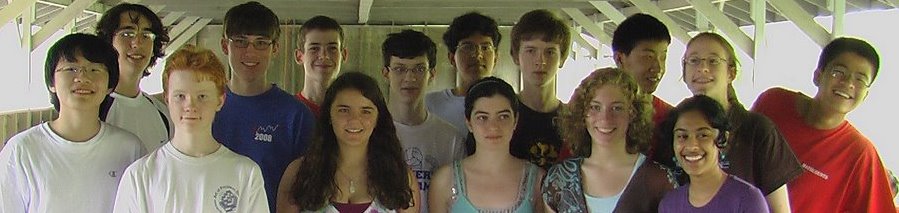
Notes from my Pythagorean Auctions session at the New York Middle School Math Teacher Workshop at Bard College are available here. I will annotate them more fully later this summer.
http://sites.google.com/site/pythagoreanauctions/
Sunday, August 1, 2010

Wednesday, July 21, 2010
Pythagorean auctions and other Pythagorean excitement for middle school teachers at Bard College next week!

As I said, why should students have all the fun?
Next Monday, I will be leading a session on Pythagorean auctions at the New York City Math Teachers Circle summer workshop for middle school mathteachers at Bard College.
The inspiration for running math auctions in my session came from an idea I first read about in the book Mathematical Circles (Russian Experience) by Dmitri Fomin, Sergey Genkin, and Ilia Itenberg. Further encouragement came from a very enthusiastic presentation by Anna Burago at MSRI's Great Circles 2009 conference. Anna has many years of experience with math circles, both as a student in her native St. Petersburg and now as a lead teacher for the Northwest Academy of Sciences math circle. Here is her description:
Mathematical Auction is an exciting team mathematical contest. It combines mathematics with the elements of gambling and psychological thriller. The game starts from a period of problem solving which is followed by a round of trading. The teams bid, scheme and strategize for the rights to present the solutions to the problems. Mathematical Auction is one of the favorite competitions in the Math Circles that I run.As an economist, of course, I was intrigued by the idea of a mathematical auction, so I had to try the idea out in our math circle. Since Anna said that the auctions are especially popular with middle schoolers, we ran some math auctions at our Albany Area Math Circle middle school math circle meetings last spring--and they were indeed very well received by the students. I hope the teachers at next week's workshop will also enjoy using math auctions to explore some interesting Pythagorean mathematics.
Here are the rules for a Math Auction:
1) The auctioneer hands the teams a set of problems--about five or six problems is considered ideal. But the problems are a special kind--Russian math circle leaders call them "research problems" because they allow possibilities for partial solutions or intermediate answers which can gradually lead to a final result.
2) Teams are given a certain amount of time to work on the problems.
3) When that time is up, the auction begins. Each team starts with a certain amount of fictional currency at the outset of the auction. In honor of Pythagoras, we'll use drachmas as our fictional unit of currency in next week's workshop, so each team will have 1,000 drachmas to use in their bidding.
4) The teams then bid for the right to present a solution to each problem. The team that submits the highest bid in the initial round of the auction gets the right to present their solution. After they present their solution, the bidding reopens so that other teams who believe they can improve on that solution may do so. The team with the strongest solution to the problem wins the value of the problem. Bonus drachmas may be awarded for cool discoveries made alone the way.
The focus of the summer teacher workshop is the Pythagorean theorem, so all the problems we will be auctioning off next Monday afternoon will use that theorem in a variety of fascinating ways--many of the auction problems will connect to the presentations that will be given by other speakers later in the week.
Here is the list of workshop presentations scheduled at the Bard math teacher summer workshop next week:
Auctions of All Things Pythagorean: Spirals, Trees, Triples, Twins, Quads, Networks, and Outcastes, Mary O'Keeffe (Albany Area Math Circle)
Showing of The Theorem of Pythagoras (movie created by Tom Apostol's Project Mathematics! at Caltech with awesome animation from MacArthur "genius" prize winner Jim Blinn )
Primitive Pythagorean Triples Sheila Krilov (Hunter College High School teacher and MATHCOUNTS coach)
Heronian Triangles David Hankin (former chair of the AIME Committee and veteran teacher/math department chair Hunter College High School)
Showing of The Proof (movie about Andrew Wiles proof of Fermat's Last Theorem)
Pythagoras in Spherical and Hyperbolic Geometry, Jim & Maria Belk (Bard College faculty)
Eight Different Proofs of the Pythagorean Theorem Gary Rubinstein (Stuyvesant High School faculty)
Fermat n=4 and Some Interesting Open Problems in Number Theory Lauren Rose (Bard College faculty)
Primitive Pythagorean Triples via Unique Factorization John Cullinan (Bard College faculty)
Almost Pythagorean Triples, and Almost Isosceles Pythagorean Triples: Connecting to Pell's Equation, Japheth Wood (Bard College faculty)

All of this mathematical excitement (as well as music and film festivals) will take place on Bard's campus next week. The area near Bard, overlooking the Hudson River, is a spectacularly beautiful setting at this time of year (word has it that Chelsea Clinton will be getting married nearby shortly after the math circle teacher workshop ends!)
There may be still room for a few more math teachers to attend the workshop--and it is even possible to arrange for continuing education credit. Please pass the word along to any middle school math teachers you know who would enjoy this experience!
Thursday, June 17, 2010
Spectacular summer math programs in Upstate NY: Part I
I'll be writing about two terrific summer math programs in Upstate New York that still have openings. One is a week-long daycamp program for middle school students and one is a week-long math immersion retreat for middle school teachers. (Because why should students have all the fun!)
This post is about the program for students. I'll write about the program for teachers later this week.
 Albany Area Math Circle alumni Dave Bieber and Markus Salasoo will again offer their summer math day camp for middle school students July 12 to 16 amid the beautiful and inspiring surroundings of the Association for the Protection of the Adirondacks in Niskayuna. Parents and siblings of math campers are welcome to walk around the grounds of the adjacent wildlife sanctuary while Dave and Markus lead their students in a week of fun "think outside-the-box" mathematics.

Dave and Markus initiated this camp in 2008, and this will be their third year of running this very well-received program. Dave has written about the first year of the camp here. Dave has also been coaching the Van Antwerp Middle School MATHCOUNTS team for the past two years. The National MATHCOUNTS organizations recognized his very successful coaching with "Coach of the Week" honors in March. Dave was the first ever student coach to receive this recognition! You can read more about Dave here.
Dave and Markus started this program as high school students, and it is great to see them build on their enthusiasm and experience continuing to run it as they move on into college: Markus is a rising sophomore at Cornell and Dave will be a freshman at Princeton in the fall.
The camp is aimed at mathematically and behaviorally mature middle school students (entering 6th through 8th grades). More information and a camp application are available here.
This post is about the program for students. I'll write about the program for teachers later this week.
 Albany Area Math Circle alumni Dave Bieber and Markus Salasoo will again offer their summer math day camp for middle school students July 12 to 16 amid the beautiful and inspiring surroundings of the Association for the Protection of the Adirondacks in Niskayuna. Parents and siblings of math campers are welcome to walk around the grounds of the adjacent wildlife sanctuary while Dave and Markus lead their students in a week of fun "think outside-the-box" mathematics.
Dave and Markus initiated this camp in 2008, and this will be their third year of running this very well-received program. Dave has written about the first year of the camp here. Dave has also been coaching the Van Antwerp Middle School MATHCOUNTS team for the past two years. The National MATHCOUNTS organizations recognized his very successful coaching with "Coach of the Week" honors in March. Dave was the first ever student coach to receive this recognition! You can read more about Dave here.
Dave and Markus started this program as high school students, and it is great to see them build on their enthusiasm and experience continuing to run it as they move on into college: Markus is a rising sophomore at Cornell and Dave will be a freshman at Princeton in the fall.
The camp is aimed at mathematically and behaviorally mature middle school students (entering 6th through 8th grades). More information and a camp application are available here.
Sunday, June 6, 2010
In memory and appreciation of Prof. Leo Schneider

Just two months ago, we were honored to have Professor Leo Schneider come to Albany for NYSML, the statewide math championship math meet, where our students, as well as students from all over New York State, got to see him in action as he helped to run the tiebreak rounds (above, with George Reuter) and subsequently explained the mathematics behind the solutions to those problems to an audience of hundreds of students.
Professor Schneider has composed many terrific problems to challenge and inspire high school students at ARML and NYSML over the years. In fact, he has written all of the problems used at NYSML for at least a decade, and he has also overseen the grading of the essay/proof-based Power Question during that time. He has also contributed AMC contest problems and volunteered with the International Math Olympiad. Our students have very much enjoyed working on many of his problems during official competitions, as well as learning more from those problems by working on them informally afterwards as they prepared for future competitions.
Yesterday, the American Regions Math League (ARML) national organization honored Professor Schneider by awarding him the 2010 Al Kalfus Award for Distinguished Service. Prof. Schneider was on-site to receive that honor, as well as to serve in his role as Chief Judge of the national high school math contest, including overseeing the grading of the power round on Appolonian circle packing.
Less than 24 hours later, we received the sad news that Professor Schneider passed away suddenly while traveling from ARML.
He leaves a remarkable legacy behind--thousands and thousands of students all over the state and all over the country, inspired and energized by the mathematical excitement he created in the problems he composed for them. And decades of future students will grow mathematically by continuing to work informally on those problems in the future.
Professor Moorthy, Mr. Babbitt, Professor Biswas, Beth Schaffer, and I had the privilege of meeting and dining with Professor Schneider and other NYSML officials the night before NYSML this year. His eyes sparkled as he talked about how he'd found inspiration for this year's Power Question in a visit to a factory that used computer-controlled milling machines. His motto was "There's a Power Question in everything!" and it's clear that his mind was constantly open to the possibility of interesting mathematics in every daily encounter.
Thank you, Professor Schneider. You will be missed, and we will think of you as we continue to work with future cohorts of students and to reflect on the mathematics embodied in the problems you have composed.

Monday, May 31, 2010
Hale and Farewell!

Yesterday's picnic was beautiful and bittersweet as we greeted our returning alumni and officially welcomed our graduating seniors into their midst. It was a pleasure to have alumni Alison and Catherine Miller, Zagreb Mukerjee, Beth Schaffer, Liz Simon, Susanna Todaro, Yipu Wang, Lindsay White, and Tom Zink join our gathering.

Our graduating seniors are going off in a variety of directions: Andrew Ardito and David Bieber are headed off to Princeton; Heidi Chen will be at Williams; Peixuan Guo will be at Columbia; Brady Pelkey at Drexel; and Anagha Tolpadi and Eric Wang will be at Cornell.
 Our sadness at seeing our seniors go is attenuated by the terrific legacy they are leaving behind--our seniors have done an outstanding job of mentoring and encouraging a record-size group of superb younger students to follow in their footsteps. A few of them are shown at left, including seventh grader Shreya Arora, standing, who received special recognition for her leadership of the delightfully named "Persistent Chickens." At left in the photo is 8th grader Cecilia Holodak, who won this year's Chapter Countdown Round, captained the first place team at Chapter, and was a member of a Science Bowl team that placed 7th in the nation. Gili Rusak (center) and Jien Ogawa (right) were the high scoring AMC8 students in the region this year. Gili also qualified for the American Invitational Math Exam (AIME) this year. Cecilia and Gili are both headed to Penn State as members of the Upstate New York ARML team this week.
 Our younger students as well as our vets have already racked up an impressive array of other accomplishments, which we will recap in coming end of year posts. We look forward to seeing our younger students and our vets attack many mathematical challenges in the future.
Meanwhile, at the other end of the spectrum, it was fun to learn news of alumni who were unable to join us. Founding member Drew Besse is in California this summer, interning at Facebook. Longtime member Nicole Bieber and founding member Manisha Padi will be marching in MIT's graduation ceremonies this week. Nicole has already begun work on her master's degree in computer science. Manisha has been studying economics and mathematics as a Burchard Scholar.
Saturday, May 15, 2010
Congratulations Matt!

Matthew Babbitt (at left above, celebrating after NYSML with teammates Zubin Mukerjee, Gili Rusak, Cecilia Holodak, and Jien Ogawa) scored high enough on the notoriously challenging 2010 USA Math Olympiad contest to qualify for an invitation to this summer's Math Olympiad Summer Program.
Congratulations! You are among a very small group of about 57 students (from the original pool of over 221,000 AMC 10 and AMC 12 participants) invited to take part in the 2010 Mathematical Olympiad Summer Program (MOSP) scheduled to begin Tuesday, June 8 and ending Wednesday, June 30, 2010. This year’s MOSP will be held on the campus of the University of Nebraska-Lincoln.
The purpose of the program is to broaden the participants’ view of mathematics and foster their excitement toward further study. It will better prepare you for possible future participation on our International Mathematical Olympiad team as well as for possible careers involving mathematics.
Full days of classes, problem solving and tests give students extensive preparation in several important areas of mathematics, including algebra, geometry, combinatorics, number theory, and many other special topics. All members of the MOSP staff are housed with the students, and will closely interact with all the participants outside of class as well. In the past this interaction has greatly contributed to the development of America’s most talented young mathematicians.
Please note that basic MOSP expenses for food and lodging will be covered by the MAA American Mathematics Competitions. We will also reimburse your round-trip travel expenses up to $400 (see attached MOSP Acceptance and Travel Agreement). Additional information about MOSP can be found in the Student Handbook. You will also receive a set of MOSP Medical Forms that your parent/guardian will need to complete, and return to us so they arrive by May 26, 2010.
I am pleased to invite you to the 2010 MOSP, and feel that this program will offer you three weeks of camaraderie with many of our country’s top math students, and activities which will make a significant difference in your mathematical education.
Sincerely,
Prof. Steven R. Dunbar
AMC Director
Cc Zuming Feng, MOSP Academic Director
Some of the factors that have contributed to Matthew's success:
1) Matthew delights in working with other students in our high school math circle and has been a key leader in our middle school math circles as well. He exemplifies one of the mottos of our math circle: the more of your mathematical understanding you share with others, the more you have for yourself. Answering the questions of other students who are struggling with a problem you believe you have solved deepens your understanding of that problem. The relationship between mentors/mentee or collaborators is mutually beneficial: the whole really is more than the sum of the parts. The photo at the top of this post shows Matt celebrating at NYSML with some of our math circle students who have enjoyed working with Matt over the past two years, starting out in our middle school math circle, where Matt has been a leader, and have now moved up to our high school math circle: Zubin Mukerjee, Gili Rusak, Cecilia Holodak, and Jien Ogawa. His interactions with them and with many other math circle members, seasoned veterans and fresh-faced rookies alike, have advanced his understanding of mathematics. In a very real sense, all members of our math circle can claim a share of the credit for his success.
2) Matthew likes to write about mathematics! He has sharpened his mathematical expository skills in many ways.
An informal, free, and fun way to start out writing about math is to participate in the Art of Problem Solving forums, where Matthew has been an active participant. Choose an interesting problem posted by another participant who wants to discuss solutions and post your ideas about how to solve it. Or post a question of your own that you've been struggling with and would like to discuss in order to understand it better. Putting your question in writing can help you sharpen your understanding of the problem. Writing down a clear description of your attempt at solving a problem forces you to think explicitly about some of the assumptions you are making.
Once a student develops comfort in writing in that informal, friendly, and highly interactive environment, the way paved for the student to move to writing in more formal settings, such as mathematics journals that post challenging problems and welcome well-written student submissions.
The Canadian Mathematical Society publishes an excellent journal called Crux Mathematicorum with Mathematical Mayhem. They post challenging problems in each issue in their "Mathematical Mayhem" section. The currently open problems are here. (They are published in French and English, so if your French is sketchy, just scroll down the PDF to the English version.) Anyone who would like to try to solve these problems is welcome to mail in their solution to Crux before June 15. The names of all successful submitters will be published in an issue next fall. In addition, Crux publishes an examplary solution to each problem in that subsequent issue as well.
Browsing through recent issues of Crux, you can see that Matthew has submitted a number of correct solutions to problems this past year, and they even published one of his solutions as a highlighted solution as well. Check out problem M379 on pages 429-430 to see Matthew's published solution to a problem submitted by Professor McLaughlin of the University of New Brunswick. It's fun and fascinating to see the diversity of the names, affiliation, and hometowns of the other people who submitted correct solutions to the same problem. In this case, the other successful submitters are listed by Crux as: Edin Ajanovic, First Bosniak High School, Sarajevo, Bosnia and Herzegovina; George Apostolopoulos, Messlonghi, Greece; Antonio Godoy Toharia, Madrid, Spain; Richard I. Hess, Rancho Palos Verdes, CA; R. Laumen, Derne, Belgium; Richard Peiró, IES "Abastos", Valencia, Spain; Mridul Singh, student, Kendriya Vidyalaya School, Shillong, India; Neculai Stanciu, George Emil Palade Secondary School, Buzău, Romania; Edward T.H. Wang, Wilfrid Laurier University, Waterloo, ON, and Jixuan Wang, student, Don Mills Collegiate Institute, Toronto, ON. (It's interesting to note that Jixuan was a member of the Canadian team at the 2009 International Physics Olympiad, where he won a silver medal, and it looks like he is leading contender for this year's team as well. Sharpening those expository writing skills comes in handy in physics too! Jixuan has also done very well on the Canadian Math Olympiad.)
There are other journals that publish excellent problems and welcome student submissions, including the Mathematical Association of America's Math Horizons magazine, where Albany Area Math Circle student Felix Sun submitted a solution that was published as a highlighted solution last year. Other magazines where you can look for problems include: the American Mathematical Monthly, Mathematics Magazine, the College Mathematics Journal, the Harvard College Math Review, and the Pi Mu Epsilon Journal.
Stop by a library at a local college and you can easily browse through recent issues of most of these journals. The Harvard College Math Review appears to have gone into a latent stage, but you can find interesting back issues to browse here.
It should be noted that all these journals welcome submissions of original problems. Most of the problems they publish are submitted by their readers. Composing a good problem can be a great way to develop your problem solving abilities. Matthew has also had one of his problems published in Crux. (Check out Problem M410 of the November issue to see Matt's problem. The list of successful solvers and a highlighted solution submitted by a reader will no doubt appear in an upcoming issue. It will be fun to see the names and hometowns of those who have worked on Matt's problem. Maybe someday he will meet one of the solvers at the International Math Olympiad!
Wednesday, May 12, 2010
Name this polyhedron?

Four years ago, scientists at Pacific Northwest National Laboratory announced their exciting and surprising discovery that gold atoms can also form beautiful polyhedral configurations, like the 16-atom gold molecule shown above. Previously, it had been thought that metals were too reactive to organize themselves in such orderly but hollow structures.
The American Mathematical Society covered the story as follows:

The recently constructed molecular cage, made of 16 gold atoms, has the shape of a truncated tetrahedron.
Add a new member to the family of nano-polyhedra concocted by chemists. This one is made of 16 gold atoms arranged to form a truncated tetrahedron: delete the four vertex atoms from the array corresponding to the tetrahedral number 20. The New York Times for May 16, 2006 reported the construction, which is described in "Existence of hollow golden cages," by Lai-Shen Wang (Pacific Northwest National Laboratory) and collaborators, in the May 30 PNAS. The authors report that this is the first time free-standing metal hollow cages have been detected in the laboratory. In fact their method produced a mixture of the Au16 cages with slightly larger ones made of 17 and 18 atoms. They note that these cages are presently empty, but that their calculations suggest that "these hollow golden cages can easily accomodate a guest atom with very little structural distortion to the host cages." In case you want to do this at home, "The gold cluster anions were produced by using a laser vaporization cluster source" and the results were anyalyzed by photoelectron spectroscopy, "using a magnetic-bottle time-of-flight photoelectron analyzer." No name has been coined yet for these miniature gold cages (inside diameter about 6Å or 6.10-10m) akin to the evocative "buckyball" for the Carbon-60 soccer-ball shaped molecules. In fact the Times's take on the story, written by Kenneth Chang, was "16 Golden Atoms in Search of a Catchy Name."
Work on the properties of the Carbon-60 Buckyball (aka "truncated icosahedron") won the Nobel Prize in physics in 1996. For those who like to play with mathematical ideas playfully, I highly recommend the "Oball" toy shown in the video below, loosely based on the buckyball/truncated icosahedron. We'll have some Oballs on hand during our annual picnic on Memorial Day weekend.
Perhaps work on the golden polyhedral molecules will win a prize as well, but a catchier name than "truncated tetrahedron" might help!
Subscribe to:
Posts (Atom)


